
How Much Does It Cost?
It depends on your system: the number and type of radiators, the pipework, the type of radiator valves, and whether you already have a magnetic filter. Our prices start at £1,087, however the calculator below will give you a more accurate estimate based on the exact number and style of radiators you have in your property in under a minute. — However, we will still need to visit and inspect your installation before we can give you a guaranteed price.
Cleaning a heating system isn't cheap, and it comes with risks we think you should know about before you decide. (If you have underfloor heating or a heat pump, unfortunately we can't help.)
Jump to the calculatorWhy you need this service
Contaminated water
Think of the water in your central heating system as working in the same way as the oil in your car engine. Over time its condition deteriorates, and when that happens, if it's not replaced, you can expect some very expensive repair bills in the near future.
Contaminated water is only half the problem. The other half is...
Corrosion
Your radiators are made of metal, which, as you know, corrodes. (Metal rusts when it gets wet!) Over time this corrosion builds up on the inside of your radiators and acts as a thermal barrier, almost like a layer of insulation on the inside wall of the radiator, slowing the transfer of heat from the hot water in the system to the room the radiator is in. This means your boiler needs to run for longer, using more gas and costing you significantly more money, just to heat the room.
On top of the higher running costs, when corrosion is allowed to build up, flakes of rust fall off the inside walls of the radiator and start to accumulate at the bottom. As water flows through the radiator, those particles end up in different places depending on their size:
Small particles
These are flushed through the system and slowly accumulate in other components such as the pump, the diverter valve and the air vents, causing them to fail and leak. Eventually they can block the heat exchanger inside your boiler, causing it to overheat and stop working.
Mid-sized particles
These are flushed out of the radiator but are too large to be carried far, so they accumulate in the pipes. Over time this can lead to a blocked heating pipe that restricts, or even stops, the flow of water to other radiators in the property.
Large particles
These aren't flushed through the system at all. They accumulate in the bottom of the radiator and stop that part from heating up, meaning the radiator becomes less efficient.
What corrosion does to a radiator
The three images below were taken with a thermal imaging camera. The blue & grey areas are cooler: this is the part of the radiator filled with rust, which stops heat transferring from the water your boiler has heated into the room the radiator is in.
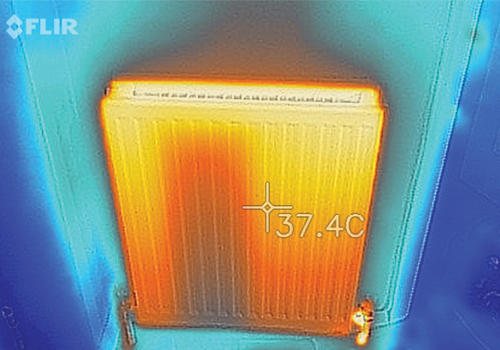
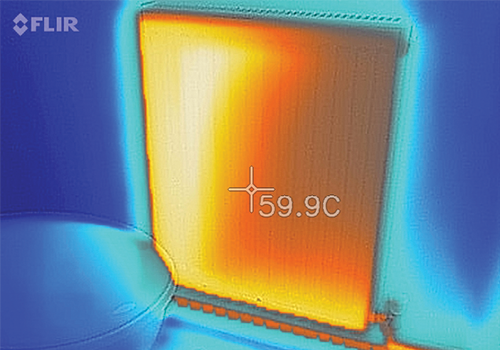
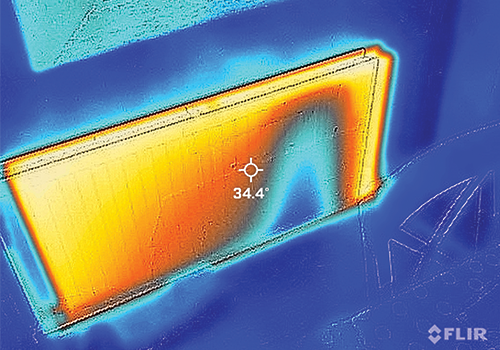
Imagine the corrosion fills the lower 20% of a radiator. That radiator can now only produce 80% of the heat it was designed to, so your boiler needs to run for longer to heat the room. And if the radiator wasn't oversized to begin with, 80% of its original capacity may no longer be enough: your boiler could be running for hours and the room still might not get as warm as you'd like.
As the corrosion progresses, the radiator itself can become blocked and stop working completely.
When you have a blocked heating system, particularly if the pipework has been installed for over 40 years, it can sometimes be more cost effective to simply have a new, more energy efficient system installed. However, for younger systems, and where the blockage is only partial (the radiators work, but not very well), the system can often be cleaned.
Cleaning the system
Power flush, Magnacleanse and Mains Flush are the names given to different methods used to clean a domestic central heating system.
Cleaning a heating system lowers running costs, reduces the risk of breakdowns, and is mandatory if you're having a new boiler installed. Where a new boiler is fitted to a system that hasn't been cleaned correctly and the boiler later breaks down, the manufacturer will likely void the warranty, leaving you with a very expensive repair bill.
However, if your system hasn't been cleaned routinely, the cleaning process comes with risks that are unavoidable, because they can be caused by the previous installer's standard of work, by a material failure, or simply by the age of the system.
Here are some of the more common problems we've personally experienced over the decades...
The risks of cleaning a neglected system
Pipe leaks
Imagine a pipe or fitting somewhere under the floor develops a small leak. It isn't big enough to form a drip: because of the heat of the pipe it evaporates as soon as it forms, leaving nothing but a small amount of water residue/scale on the pipe's surface, so you have no idea it's happening. (They can look like the video below.)
Over time this repeats until the scale blocks the leak completely. Inside the pipe, the corrosion carries on and the hole keeps getting bigger; it just isn't leaking due to the scale that has formed around it. A pipe can corrode like this and go unnoticed for years.
When the system is cleaned, whether by power flush, Magnacleanse or mains flush, the scale that has formed is removed and a leak appears.
If that pipework is upstairs, the leak will drip onto the ceiling of the room below and you'll notice a water mark developing over the coming weeks, or in extreme cases you may have water coming through the ceiling. In this situation, imagine the room above is a bedroom containing a large bed, a wardrobe and other furniture, with a laminate floor. The room now needs emptying, the laminate needs removing, and the floorboards need cutting and lifting to find the pipe so it can be fixed. That is hours of work that cannot be avoided.
The cleaning process has not caused this leak; it has simply exposed a leak that was already there. But if a client doesn't understand how the cleaning process works and what it does, it can be very difficult to explain why the leak isn't the fault of the person cleaning the system, and why they'll need to charge for the repair that follows. Without lifting every floorboard in the house and visually inspecting every pipe, fitting and valve, these leaks cannot be prevented.
Pipe blockages
Plastic pipes are renowned for developing very large flakes of corrosion along the wall of the pipe. Over time these break away and can become lodged in the plastic fittings, causing an obstruction that the cleaning process alone may not clear. (See the videos below.)
When this happens it can sometimes be necessary to cut out and replace a section of the pipework to clear the blockage.
Radiator damage
Part of the cleaning process involves an agitator. This is a device attached to a drill; the drill is set to hammer action only, and the subsequent vibrations cause the corrosion on the inside of the radiator to breaks away where it can be collected in a magentic filter. (Image below.)
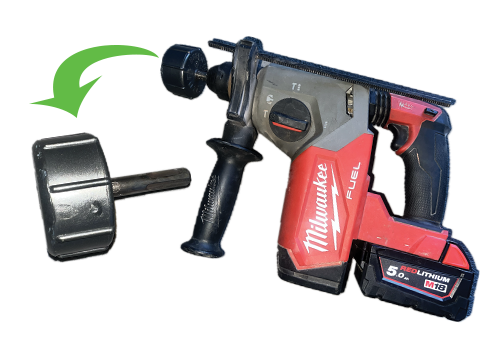
If you have any radiators that have been painted/decorated, there is a good chance the paint may chip or flake off. Sometimes the colour coating on designer style radiators can also become damaged if they are starting to corrode. Unfortunately, if you want the best cleaning results, the agitator is essential.
Vertical & Designer Radiators
Verical or designer radiators are more problematic to clean because of their design, and in some cases, even with the use of an agitator, the results can be less than optimal.
Radiator valves
The cleaning process involves repeatedly turning the radiator valves on and off. If a valve is seized this may not be possible, and if a valve is old it may not fully isolate the flow of water. Older valves can often leak with repeated use.
Valves can also come away from the pipework when the agitator is used, if they haven't been installed correctly.
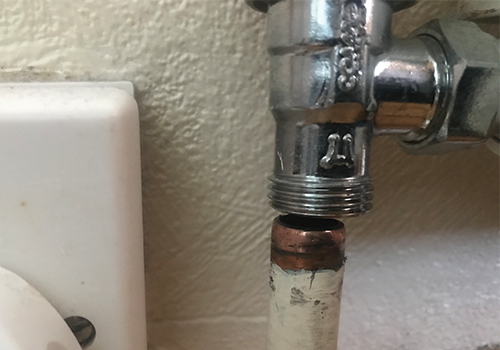
In the image below you can see a pipe that became dislodged from a radiator valve during the cleaning process. The previous installer had cut the pipe too short, so the connection wasn't secure, and the vibration from the agitator caused it to come away from the valve, spilling water and chemical cleaner on to the floor.
Why we do not accept liability for leaks or damage
Having read the above and looked at the photos and videos, I am sure you will agree that it is simply not possible for a company to accept liability for any leaks and/or damage that may arise from cleaning a heating system. A leak may be a result of the age of the system, it may be due to the previous installer's standard of work, or it may be due to low quality materials.
Therefore, if you choose to have your system cleaned, we will not accept liability for any leaks/damage that arise, and we will ask you to sign a digital disclaimer before work begins to confirm you understand and accept these facts.
How we lower these risks
Over the decades we've introduced a number of measures that lower the chances of these problems arising, and reduce the impact of any leaks that do. We can't eliminate the risks, but we can lower them in the following ways.
- We replace every radiator valve first. Radiator valves have a high risk of leaking, if not during the cleaning process then soon after, so we insist on changing all the radiator valves in the property before cleaning starts. This lets us be sure they will turn off and, more importantly, that they've been fitted correctly and won't vibrate loose when the agitator is used. This may seem like we're creating extra work, but most radiator valves only come with a 12 month warranty from new. (Essentially, the manufacturer expects them to last 12 months without any problems but can't guarantee they'll last any longer.) If your radiator valves have been installed for longer than 12 months, they're already at the end of the manufacturer's warranty. If you have a very old radiator, the valve may not come out without damaging the radiator, and you may need a new radiator.
- We inspect every radiator for corrosion. If we find one that is corroding, we'll show you, and depending on the severity we may refuse to clean the system unless the corroded radiator is replaced at the same time.
- We make sure the system can be drained quickly. If a leak arises during the cleaning process, or is noticed in the weeks afterwards, we want to be able to drain the heating system as quickly as possible. This may mean replacing some drain valves to be sure they operate or, where possible, modifying the pipework slightly so the system can be drained quickly.
- We fit a magnetic filter if you don't have one. A magnetic filter has been a mandatory requirement for all new boiler installations for a number of years. It gives your system ongoing protection, and it also gives us a point to connect our cleaning equipment to your heating system to carry out the flush.
Heating system cleaning calculator
While this calculator gives you an estimated cost to clean your system, it is not a guaranteed price. We will still need to visit your property to confirm the price applies to your installation because things like, corroded radiators, a noisy pump, corroded pipes attaching to the radiator valves, non-standard radiator valves, etc, can all impact the cost, but the calculator should give you a close estimation for the work.
If the estimate works for you
If the estimate from the calculator is acceptable to you, the next step is to schedule the Central Heating Assessment that applies to every job. This service is priced at £97 and allows us to inspect your installation for the things listed above that let us lower the risk of leaks, and to give you a fixed price for the cleaning process.
Cleaning the heating system is not cheap, but if corrosion is allowed to progress it will only get worse, and there will come a point where cleaning is no longer a cost effective solution and the system will need to be replaced, costing far more!
Book Your Central Heating AssessmentWhy we might decline your request to clean your system.
Having completed the Central Heating Assessment at your property, if it is concluded that the system is beyond cleaning, maybe you have multiple radiators that are blocked and not working? Maybe you have a DIY/Handyman type installation and the system would not survive the cleaning process in one piece? Maybe you have corroded radiators that you do not want to replace? In some circumstances we may decline your request to clean the system.
When a system is beyond cleaning, we will advise you on your options to address the problems we have identified.
Before You Contact Us. . .
Assuming you. . .
- Want the work to comply with all regulations.
- Want the work carried out to a high standard.
- Accept we will not be the cheapest company in town.
- Understand and accept the risks explained above, including that we cannot accept liability for leaks or damage that cleaning exposes.
. . . then there is just one last question to determine if we are the right company for you? . . . Would you object to having 'Freddy' in your home while the work takes place?
If you have no objections to Freddy being in your home while this work takes place, contact us using the button below to schedule your appointment now.